
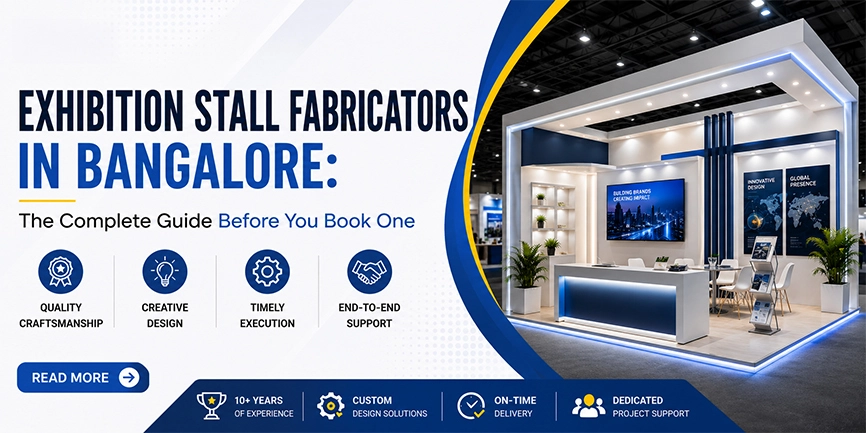

Exhibition Stall Fabricators in Bangalore: The Complete Guide Before You Book One
Picking the wrong stall fabricator is one of those mistakes you only notice three days before the expo, when the "3D render" you approved looks nothing like the panel sitting in the warehouse. This guide breaks down what good exhibition stall fabricators in Bangalore actually do, how design and fabrication differ, what drives cost, and how to choose a partner who won't call you in a panic the night before setup.
WHAT MAKES A GOOD EXHIBITION STALL FABRICATOR IN BANGALORE?
A good fabricator handles three things well: structural build quality, on-time delivery, and venue compliance. Everything else — flashy portfolios, big promises — matters far less than these three.
Bangalore hosts some of India's largest industrial and tech exhibitions, which means fabricators here deal with strict hall regulations, tight load-in schedules, and demanding corporate clients. A team that regularly works with stall fabricators in Bangalore networks understands local venue rules, vendor access timings, and material restrictions that outside contractors often miss.
The best way to judge a fabricator isn't their homepage. It's whether they can show you real photos from real halls — not stock renders that could belong to any city.
WHY DOES BANGALORE MATTER SO MUCH FOR EXHIBITION STALLS?
Bangalore isn't just another exhibition city — it's home to one of India's largest dedicated exhibition venues, and that scale shapes everything about how stalls get built here.
The Bangalore International Exhibition Centre (BIEC), spread across a 57-acre campus with roughly 77,200 square metres of pillarless exhibition space, regularly hosts national and international shows across manufacturing, machine tools, IT, biotechnology, and construction. Events like IMTEX, EXCON, India ITME, and Bangalore Bio have all been held there over the years.
That concentration of large-scale, high-stakes events is exactly why demand for serious exhibition stall fabrication in Bangalore stays strong year-round — not just during a short "expo season" like some smaller cities experience.
India's broader events and exhibitions industry backs this up. Independent market research from Mordor Intelligence values the sector at roughly USD 5.6–5.7 billion in 2025, projected to cross USD 8–9 billion by the early 2030s, growing at close to 8% a year. B2B exhibitions alone account for more than half of that market — which tells you this isn't a shrinking industry looking for reasons to exist.
STALL FABRICATION VS. STALL DESIGN: WHAT'S ACTUALLY DIFFERENT?
Fabrication is the physical build — structure, materials, on-site assembly. Design is the creative and spatial planning that decides what gets built in the first place. Most businesses need both, but they're not the same skill set.
An exhibition stall designer in Bangalore focuses on layout, visitor flow, branding placement, and how the space feels when someone walks in. This is where 3D renders, mood boards, and material selection happen before a single panel gets cut.
Exhibition stall fabrication is the execution stage — welding, carpentry, printing, electrical work, and structural assembly, followed by transport and on-site installation. A fabricator without design sense builds a technically sound but forgettable stall. A designer without fabrication expertise draws something that looks great on paper and falls apart under real venue conditions.
This is exactly why the strongest stall designing services in Bangalore are usually offered by teams that do both in-house, rather than outsourcing one half to a subcontractor they don't control.
HOW MUCH DOES EXHIBITION STALL DESIGN AND FABRICATION COST IN BANGALORE?
There's no single number here, and anyone who quotes you a flat rate without asking questions first is guessing. Cost depends on stall size, material choice, custom vs. modular structure, branding complexity, and how many days you need the crew on-site.
A modular stall built from reusable Octanorm panels costs meaningfully less than a fully custom structure with bespoke woodwork, raised flooring, or double-decker elements. Custom builds take longer to fabricate but offer far more brand differentiation on a crowded expo floor.
Rather than chasing the lowest quote, ask for a cost breakdown by category — structure, graphics, furniture, electrical, and labour. That breakdown tells you exactly where your budget is going, and it's the fastest way to spot a fabricator padding numbers in one hidden line item.
WHAT DOES THE STALL FABRICATION PROCESS ACTUALLY LOOK LIKE?
The process runs in five stages: brief, design approval, fabrication, installation, and dismantling. Skipping or rushing any one of these is where most stall disasters start.
- Brief and site visit — understanding your brand, booth size, and hall-specific rules (power load, height restrictions, fire safety).
- Design and 3D approval — this is where you should ask hard questions, not just say "looks nice."
- Fabrication — off-site build of structure, printing of graphics, furniture sourcing.
- Installation — on-site assembly, usually within a tight 24–48 hour move-in window before the show opens.
- Dismantling — teardown and removal, which venues like BIEC enforce strictly on schedule.
A fabricator who explains this timeline clearly before you sign anything is more trustworthy than one who just says "don't worry, we'll handle it."
CUSTOM, MODULAR, OR RENTAL — WHICH STALL TYPE SHOULD YOU CHOOSE?
Choose custom if brand differentiation matters more than budget. Choose modular if you're exhibiting multiple times a year and want reusability. Choose exhibition stall rental in Bangalore if this is a one-off event or you're testing a new market.
Custom stalls are built once, for one specific footprint, and usually can't be reused elsewhere without rework. They cost more upfront but deliver the strongest visual impact.
Modular systems use pre-engineered components that can be reconfigured for different hall sizes across multiple events. This is the practical choice for companies attending three or four expos a year.
Rental is underrated. For a single event, or a company still deciding whether a particular trade show is worth repeat investment, renting avoids locking capital into a structure you might only use once.
WHY DOES STALL DESIGN ACTUALLY MATTER TO YOUR ROI?
Because visitors decide whether to stop within seconds — and a forgettable stall never gets the chance to make its pitch. This isn't opinion; it's fairly well-documented in exhibition industry research.
According to CEIR (Center for Exhibition Industry Research), booth layout is one of the top three factors driving visitor dwell time, and dwell time correlates directly with lead generation. Separate industry research found that close to half of attendees say a booth's visual appeal is the main reason they decide to stop and engage at all.
Most design psychology studies on exhibition spaces point to a similar window — somewhere between three and seven seconds — for a visitor's brain to form a snap judgment about whether a stall is worth approaching. Cluttered signage, unclear branding, or a generic layout can quietly cost you foot traffic you never even realise you lost.
This is precisely why "cheap" fabrication so often turns out expensive — a stall that fails to stop anyone walking past has a real, if invisible, cost.
IS EXHIBITING AT TRADE SHOWS STILL WORTH IT IN 2026?
Yes — and the data backs this up more clearly than most marketing channels can claim. CEIR research consistently finds that around 81% of trade show attendees actually hold buying authority for the products on display, which is a strikingly high number compared to most digital ad audiences.
Industry benchmarking also shows trade shows contribute to roughly a third of new business generated annually for companies that exhibit regularly, according to compiled data from CEIR and Display Wizard. That's not a small side channel — for many B2B companies, it's one of the biggest.
None of that value gets captured, though, if the stall itself doesn't hold attention long enough to start a conversation. The stats above only work in your favour if your booth is actually good enough to be noticed.
WHAT SHOULD YOU LOOK FOR IN AN EXHIBITION STAND CONTRACTOR FOR BIEC?
Look for someone who's actually built inside BIEC before, not just someone claiming "pan-India experience." Venue-specific knowledge saves real time and avoids on-site surprises.
A reliable exhibition stand contractor for BIEC understands hall-specific power load limits, loading dock access timings, height restrictions per hall, and the exact dismantling deadlines the venue enforces. This isn't generic exhibition knowledge — it's specific to how BIEC's halls, ranging from mid-size spaces to the larger column-less halls, actually operate day to day.
Ask any shortlisted contractor a simple test question: "Which BIEC hall have you built in most recently, and what was the move-in window?" A fabricator with real BIEC experience answers this instantly. One without it starts talking in vague generalities.
FINAL THOUGHTS
A stall is not decoration — it's a temporary storefront that has a few seconds to convince a stranger you're worth their time. The businesses that treat exhibition stall design in Bangalore as seriously as they treat their actual product tend to walk away from expos with the leads to show for it.
Whether you need a fully custom build, a modular system for repeat events, or a straightforward rental for a one-off show, the right fabricator will ask more questions than they answer in the first meeting. That's usually the best sign you're in good hands
Frequently Asked Questions
HOW LONG DOES EXHIBITION STALL FABRICATION TAKE IN BANGALORE?
Most standard stalls take two to four weeks from design approval to completion, depending on size and customisation level. Complex custom builds with intricate woodwork can take longer, so book at least a month ahead of your event date.
WHAT'S THE REAL DIFFERENCE BETWEEN A STALL DESIGNER AND A STALL FABRICATOR?
A designer plans the layout, branding, and visual concept. A fabricator builds the physical structure. Many Bangalore-based companies offer both under one roof, which usually means smoother execution and fewer miscommunications.
CAN I RENT AN EXHIBITION STALL INSTEAD OF BUILDING A CUSTOM ONE?
Yes, and it's often the smarter choice for a single event or a first-time exhibitor testing a new trade show. Renting avoids sinking budget into a structure you might use only once.
DO FABRICATORS HANDLE INSTALLATION AND DISMANTLING AT BIEC?
Reputable fabricators manage the entire cycle — fabrication, transport, on-site installation, and dismantling — within BIEC's enforced move-in and move-out windows. Always confirm this is included before signing a contract, since some smaller vendors quietly outsource installation to third parties.
Exhibition Stand Services
Across Major Cities & Markets
From creative booth design to fabrication and installation, we deliver end-to-end exhibition stand solutions across India, the Middle East, Europe and Asia.
Click on any city to explore our local exhibition stand services.
 Hyderabad
Stall Fabricators
Hyderabad
Stall Fabricators
 Dubai
Stand Fabricators
Dubai
Stand Fabricators
 Bangalore
Stall Fabricators
Bangalore
Stall Fabricators
 Mumbai
Stall Fabrication
Mumbai
Stall Fabrication
 Pune
Stall Design
Pune
Stall Design
 Delhi
Stall Fabricators
Delhi
Stall Fabricators
 Chennai
Stall Fabricators
Chennai
Stall Fabricators
 Germany
Stand Builder
Germany
Stand Builder
 Singapore
Stand Builder
Singapore
Stand Builder
 Bangkok
Stand Builder
Bangkok
Stand Builder
 Tokyo
Stand Builders
Tokyo
Stand Builders
 Shanghai
Stand Contractor
Shanghai
Stand Contractor
 Hong Kong
Stand Construction
Hong Kong
Stand Construction
 South Korea
Stand Builder
South Korea
Stand Builder
 Kuala Lumpur
Booth Contractor
Kuala Lumpur
Booth Contractor
 Ho Chi Minh City
Stand Builder
Ho Chi Minh City
Stand Builder
 Jakarta
Booth Designer
Jakarta
Booth Designer
 Philippines
Stand Contractor
Philippines
Stand Contractor
 Beijing
Stand Builder
Beijing
Stand Builder