- 15+ Years Experience
- 700+ Brands
- India | UAE | Europe | USA
Booth fabrication turns approved designs into show-ready structures through workshop carpentry, metalwork, electrical prep, finishing, and quality inspection.
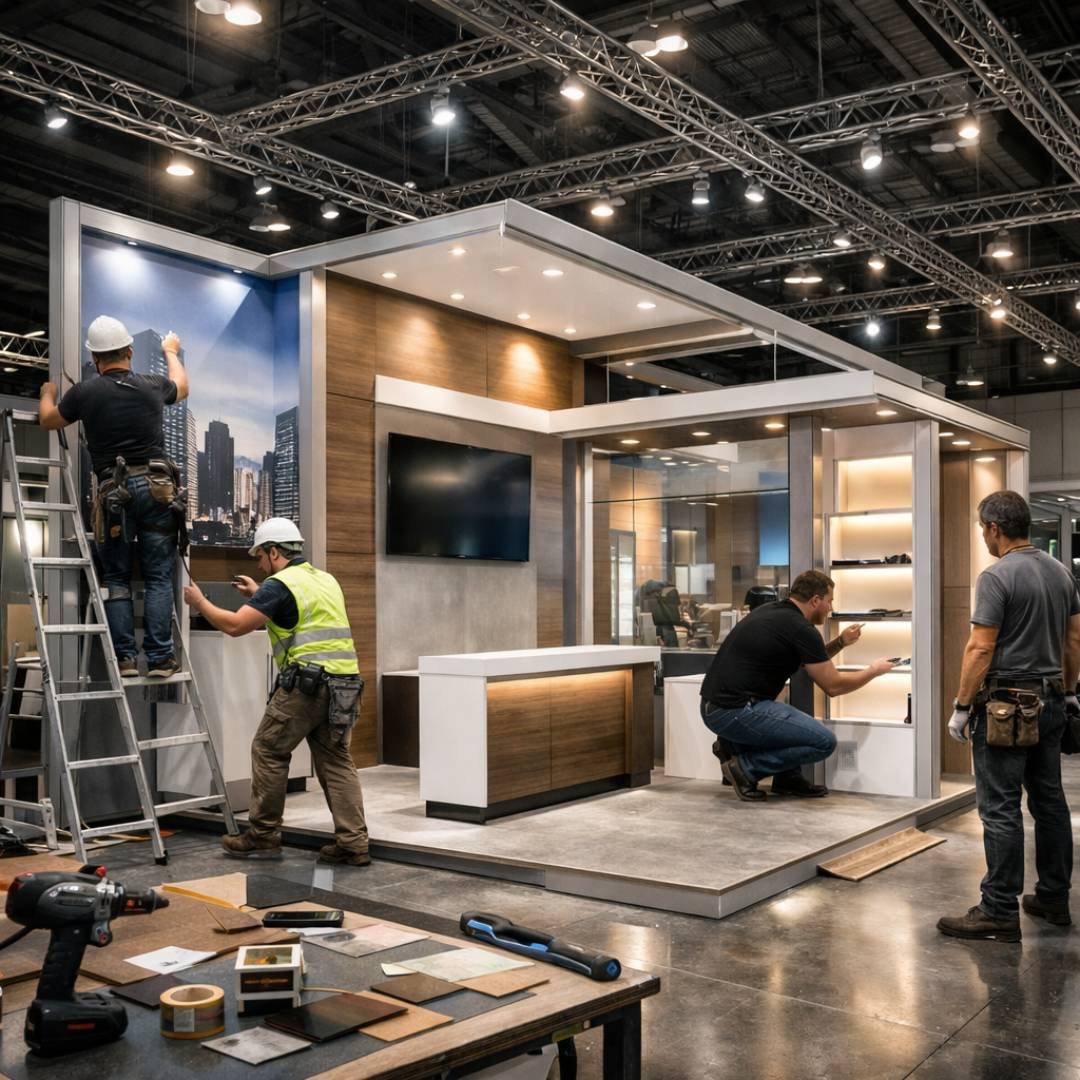
Booth fabrication is the workshop stage of exhibition stand production. It's where an approved design stops being a file on a screen and becomes panels, counters, frames, and finished surfaces you can actually touch. This page covers what happens inside our production facility — cutting, building, wiring, finishing, and checking a booth before it's ready to leave the workshop.
If you're looking for on-site installation, venue coordination, or event-day execution, that's handled on our trade show booth fabrication page. Here, we're talking about production, not the show floor.
Read MoreBooth fabrication covers everything needed to physically build an exhibition stand from an approved design — structural frames, panels, counters, storage units, lighting fixtures, flooring, and branded elements.
In practical terms, that means:
Design decides what the booth should look like. Fabrication is where someone actually has to make it stand up.
These three stages get lumped together constantly, and it causes real confusion when clients are budgeting or scheduling. They're not the same job, and honestly, they're not even done by the same skill set.
A good rule of thumb: if it happens before the booth leaves the workshop, it's fabrication. If it happens at the venue, it isn't.
An approved design becomes a physical booth through a sequence of production steps — technical drawings, material cutting, assembly, wiring, finishing, a full dry-fit, and then packing. Skipping steps is how booths arrive at venues with problems nobody caught in time.
The general workshop sequence looks like this:
That dry-fit step, by the way, is the one shortcuts get taken on most often — and it's usually the one that matters most.
Booth fabrication typically uses wood-based panels, aluminium framing, acrylic, fabric tension systems, and eco-composite materials — each chosen for a different mix of weight, durability, reuse potential, and finish.
Material choice isn't just aesthetic. It affects weight, crate size, reuse cycles, and even how the booth behaves under venue lighting rigs.
From compact rental booths to premium custom-built stands, our team designs, fabricates, ships, installs, and hands over exhibition spaces that look sharp on the floor and work hard for your brand.
Booth fabrication runs on four core trades working together: carpentry for panels and cabinetry, metalwork for structural framing, electrical prep for power and lighting, and finishing for the visible surface quality.
Carpentry builds counters, storage units, reception desks, and most custom panelling. It's precision joinery work — a counter that wobbles during a live demo isn't a small problem.
Metalwork handles structural framing, particularly aluminium truss and support columns for taller or multi-level structures. This is where double-decker fabrication really lives or dies.
Electrical preparation means routing cable containment, positioning junction boxes, and planning power points before panels close up the frame. Many venues also require specific fire-rating or safety standards for materials and wiring — worth checking your venue's technical manual before finalising specs, since these vary by location.
Finishing covers paint, laminate, veneer, or vinyl application. Note: printed graphics and branded print installation are handled in detail on our exhibition graphics and printing page — here, finishing refers to the underlying surface treatment, not the printed artwork itself.
Pre-assembly means building the booth, or its largest sections, fully inside the workshop before it's disassembled for transport. It exists for one reason: to catch problems while they're still cheap and easy to fix.
A misaligned panel, a cable that's two centimetres short, a counter that doesn't sit flush — these are minor headaches in a workshop with tools and time on hand. At a venue, with a load-in window measured in hours, the same issue is a genuine crisis.
Pre-assembly typically checks:
If it doesn't fit in the workshop, it won't magically fit at the venue.
Structural stability checks confirm a booth can safely support its own weight, any upper-floor loads, and normal foot traffic — before it ever reaches a venue floor.
Key checks at this stage include:
None of this is glamorous work. It's also the difference between a booth that stands quietly through a four-day show and one that needs an emergency fix on day two.
Larger and more structurally complex booths need more workshop time, more engineering input, and more careful crating — size and complexity scale fabrication effort, not just material cost.
A small shell-scheme refresh might need panel work and finishing and little else. A large island booth with a raised floor, custom joinery, and integrated lighting needs structural engineering input, multiple trades working in sequence, and a longer pre-assembly window. Double-decker structures add load calculations and staircase construction on top of that.
The practical takeaway: fabrication timelines and workshop resourcing should be discussed early, once size and design complexity are known — not assumed from a generic estimate. [Insert current typical workshop lead-time ranges here once confirmed.]
Most fabrication problems trace back to the same handful of shortcuts — skipping the dry-fit, underestimating structural loads, or ignoring venue material rules.
Most of these aren't design failures. They're workshop discipline failures — and they're avoidable with a proper pre-assembly and inspection stage.
Each booth type places different demands on the workshop — custom builds prioritise unique joinery and finishes, modular systems prioritise standardised connectors and reusability, and double-decker builds prioritise structural engineering.
We focus specifically on the workshop stage — production, materials, and quality control — rather than treating fabrication as an afterthought to design or logistics.
Fabrication runs smoother when we have the full picture upfront — no back-and-forth once cutting has started.
Please share: